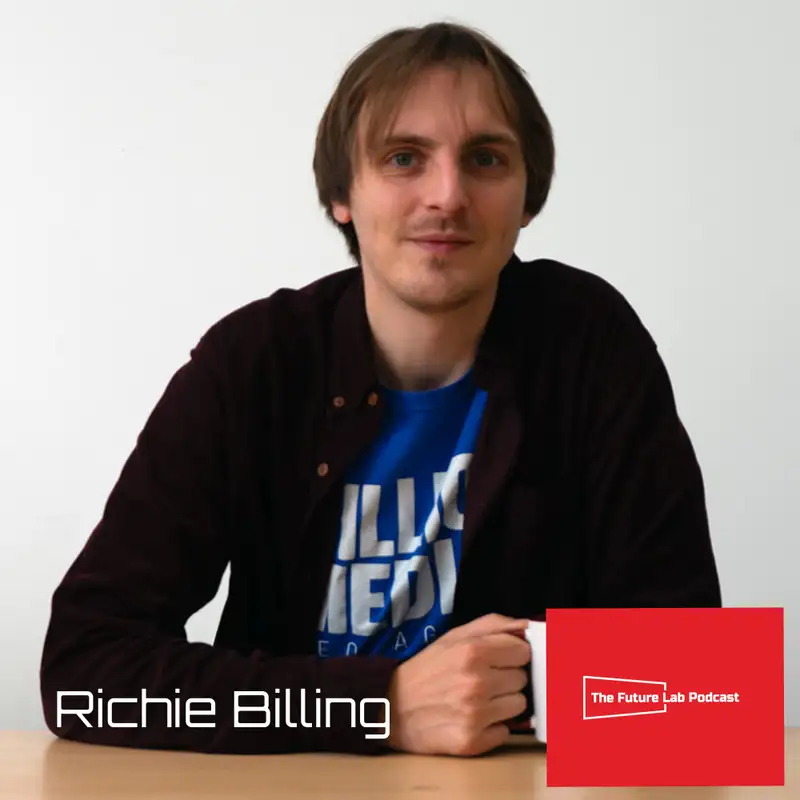
Richie Billing
Lee Schneider (00:01) Richie, welcome to the podcast.
Richie Billing (00:39) Thank you very much for having me back, Lee. It's great to see you again.
Lee Schneider (00:43) It's great to have you back. This is part of a series I'm doing called "Checking In With." So your timing, as I said, was very good. So let's start with the new book. You can tell us a little bit about it. And my specific interest right now is tone. It blends dark fantasy and comedy, which is kind of a tricky tonal blend. You're doing it, it's working.
But let's start talking about that.
Richie Billing (01:14) Yeah, so it is quite interesting because the last time we spoke, it was about Together We Rise, which was a dark fantasy novella. Very much no comedy in there. And I think it gets you down after a while when you're so focused on these serious, heavy-going issues. I felt like I needed a bit of comedic relief, and that's why I started writing The Breakaways, and
I decided early on that it was going to be like a sitcom. But I didn't want to lose the dark fantasy elements. For me, dark fantasy at its core is gritty, it's real. Things go wrong, people die, people get hurt. And I like that. I think it's just quite normal, but I thought it would be hilarious to put, like...
Lee Schneider (02:04) Mm-hmm.
Richie Billing (02:12) a group of idiots in this really dangerous world. And I decided just to start writing it and serializing it on Patreon, just to release a chapter a week. And as it's gone on, I'm sure you can relate to this as a writer yourself, you get to know the characters, they begin to develop, and the story just takes on a life of its own.
And it doesn't really feel like I've been writing it for that long, but I'm at the stage now where I've written so much it's probably enough to go into a novel. So that's what I've done. I've pieced it all together, and the story is split into four parts, which is how I wrote it. So I would just write a part of the story, and there might be
five, six, seven chapters in that part, and it's usually centered around a contract. So this world of The Breakaways is overrun by monsters, and these monsters cause all kinds of trouble. In one part of the story there are dogmen, which have come into contact with this remote mining community, and these dogmen have just killed them all, basically.
So they need a crew of monster hunters to jump in and save the day. But these guys are pretty useless. They're going in very much underestimating things and making mistakes, getting things wrong. I mean, I try and keep it relatable. Like if you're at work, you make mistakes. But in this line of work, the consequences are pretty severe.
Lee Schneider (04:05) Yes, exactly. I wanted to ask about the kind of... it's not quite seat-of-the-pants, but it's interesting that you say you get to know the characters, right? You're serializing this, you're kind of learning about them as you go. And the characters kind of audition for parts; they have scenes that maybe they do well in, maybe they don't. It's kind of like directing a messy improv troupe of actors.
Richie Billing (04:34) Yeah.
Lee Schneider (04:35) But I'm curious about the sort of spidey sense, or what alarm goes off in you that says, I'm on track, I'm off track, because it doesn't read messy, if that's a good way to put it. You know, it reads tight, not in the sense of being unpleasant, but it has pace. I know where it's going. But did it feel that way when you were writing it? And what kind of sense goes off in you
Richie Billing (04:47) Yeah. Thank you.
Lee Schneider (05:04) to keep you on track?
Richie Billing (05:06) Well, I think keeping the story segmented has helped a lot, because if you've got to do a contract, you know where it's going to end, roughly. How you get there is where I like to leave it open a little bit, and that unpredictability hopefully filters into the story a bit better. Now, sometimes you have to go back and you're like, this is quite boring,
nothing's really happening. The same thing keeps happening. I've done this before. How can I mix it up? How can I increase the stakes? And one thing I love, I don't know about you, Lee, is when you're writing stories you just want to make your characters' lives a bit of a challenge for them. It's almost a bit sadistic. It's like, can I make their life worse? Like poking
a guinea pig or something like that through the cage. But it's what makes the story interesting.
Lee Schneider (06:05) Ha ha ha.
Lee Schneider (06:12) Yeah, definitely. Putting your characters in trouble and sometimes getting them out again, that's kind of the key. You know, if you had to boil down a lot of storytelling, that's kind of it. I wanted to ask about relatability, because a lot of times in this genre, the dark fantasy genre, things do get grim on purpose. And the characters can be kind of dislikable, or at least unpleasant, maybe.
And there's a genre where, great, you know, they're monsters, they're all horrible. But these people are screwing up, they're making a mess of things, and it's kind of comic. Is that planned? I mean, how did that emerge when you were working on the characters? Did you say, probably not, right, "I need to make these characters relatable, so I'll have them screw up"? Or is it just something that organically came about?
Richie Billing (06:54) Yeah.
Richie Billing (07:06) Yeah.
No, it's a good question, because it sort of comes back to the first one that you asked, about striking that balance between the darkness and the humor. And like you described before, I wanted to keep the world very much dangerous. But having certain individuals navigating their way through it, I thought it would only work with certain kinds of personalities. So.
You've got four characters. You've got Benzan, who's the leader. He's a little bit older than everyone, and he's seen things and navigated his way through them. We've got Hilda, who's a bit younger than Benzan. She's a tracker, and she's a bit more competent. She's definitely the most competent of the crew, but she makes mistakes just like us all. I think this is how you get into the relatability side, because you just want to show that
this is a difficult job. These people might not necessarily be qualified to do it, especially in the case of the other two characters, which are Lucas and Dudley. Now, they're early twenties, a bit green, a bit naive, full of false bravado. And what I decided to do, because it's almost like cheating, but it's not like I've exactly copied:
I thought about fictional comedic characters that I really enjoy watching, and I loosely based certain characters on them. Lucas is loosely based on a character I really like in a sitcom called People Just Do Nothing, and the character is called Steves, and he's this sort of lanky...
Richie Billing (09:07) He's just a bit of an idiot, but he comes up with quite funny things. And that's what I wanted Lucas to be a bit like. He's just a stupid, moaning idiot, really. And he makes mistakes.
Lee Schneider (09:20) But you somehow make it charming. I think the secret sauce there is that they're worth hanging around with as a reader.
Richie Billing (09:32) Yeah, I think... I don't know if you've got a group of friends, like I'm quite lucky to have a group of friends that we all went to school with. And when we get together, which feels very rare nowadays as we're getting older, we're always talking. It's like being back at school, and you're just ripping into people, you know, people we used to go to school with, or teachers, or each other, and that very fast-paced back and forth. It's like...
I mean, when it's Scousers, it's hard to understand. But generally, when you see a group of friends like that, it's entertaining to watch, and you almost feel like part of it. So I suppose I was trying to replicate that. It's almost like being in a schoolyard or a work yard or something like that. They're just out in the open killing monsters instead of in a carpentry shop.
Lee Schneider (10:28) Right.
Yeah, it definitely works. I think one of the reasons it works is there are rules in this genre, like there's a contract and you have to honor the contract. But there are also things that you're breaking. You know, these are not hyper-competent people. And usually when you read, say, a heist or caper book, or a Jack Reacher novel or something like that, people are hyper-competent.
Not the case here. So I wanted to ask: what rules of the genre are you following, and what rules are you purposefully flouting or breaking?
Richie Billing (11:00) Hmm.
Richie Billing (11:11) It's a really good question. So I always try and follow the main guidelines. Like, what would competent people do in this situation? And sometimes I'll find myself writing the story and I'll be like, this is too good for them. They're doing too well. They need to trip up. Someone needs to take their eye off the ball. So that's when you go back and you're like, all right, what could I do in this situation? Could...
Lee Schneider (11:30) Mm.
Richie Billing (11:40) someone fall over? Silly things, almost slapstick. It's almost like Laurel and Hardy kind of humor, or Charlie Chaplin. I like all that. I like watching videos of people falling over. It's schadenfreude, I'm afraid. But having a cast of characters who are quite quirky anyway, I put them in funny situations where they're, like,
Lee Schneider (11:55) Yeah.
Richie Billing (12:10) dropping things and unable to reload the crossbow, or trying to get up and then slipping over straight away and knocking themselves out. You can have fun with it. And that's the whole point, I suppose. After Together We Rise, writing something quite political and heavy, it's nice just to think, all right, we've got something serious, but how can we make it funny? And I think, I mean,
you're reading it, Lee, and I enjoy writing it. Some people don't like it because they expect dark fantasy to be grimdark. But the fantasy genre is ever-changing.
Lee Schneider (12:54) Well, you said in our notes before we spoke, there's a certain pleasure in writing something comic in dark times. And what I'm enjoying as a writer and a reader is the sort of "stretch it but don't break it" ethos. You know, let's take this as far as we can, but there's still a contract and there are still some rules of this game
Richie Billing (13:04) Yeah.
Richie Billing (13:12) Yeah.
Lee Schneider (13:21) that we have to play, because if we break those rules, I'll stop reading. But I like the way the characters can be fringe or just plain old incompetent. And you still get the sense that it's going to work, as a reader. I mean, knowing you, I know it will work. But if I were just picking it up out of the blue, I'd have the sense of, well, okay, I get it. The game's here, we're pushing it as far as we can, but they're still gonna do this thing, whatever this thing is.
Richie Billing (13:35) Yeah.
Richie Billing (13:50) Yeah, I suppose a bit of the vibe underpinning it all is that every dog has its day.
Lee Schneider (13:58) Uh-huh. Mm-hmm.
Richie Billing (13:59) We've all been in that situation as well, so we can all relate to what we've seen. Those sort of glorious moments.
Lee Schneider (14:08) Yes. Now, you've done this before, meaning you're an expert at selling books directly to readers. You know the logistics, you know the benefits, you know some of the drawbacks and the things to watch for. Let's break that down a little bit. What made you decide, first of all, to go direct to readers through a Patreon?
Richie Billing (14:34) So I realized that selling books on Amazon is not really sustainable to do long term. You're at the whims of an algorithm that is secretive and can change, and has changed, with AI and things like that. And the royalties are so bad for what they do, it's insane. So I was
speaking to people. I actually had Joanna Penn on the podcast, and she was one of the first people to really discuss selling directly with me. And I just thought, let's give it a go, because we're in a new age now with technology, and all these new services support the independent publishing side of the industry. And
they make it really easy, and you can actually produce better-quality books for less and get paid more. So it's a no-brainer. And with Patreon specifically, I mean, what do we all do really? We work nine-to-five jobs or whatever to try and get a salary. And that's just money coming in every month that you can
use to live on, and that's what Patreon offers. It's a salary. It's bringing in regular income. And while selling books is good, you'd rather have someone pay £2 a month or whatever for the whole year than buy one book where you just get £2. And to me, I think it's actually a worse experience for the reader, because if you like an author,
I mean, I want to read more from them and I want to learn more. I want to almost develop a bit of that connection. And you can't really do that if you're just buying a paperback off Amazon. So with Patreon, and with The Breakaways especially, one of the best things for me is bringing in the community, bringing in the readers, the people who are really enjoying the story, and involving them in it, giving them opportunities to name characters, to create characters,
Richie Billing (16:59) and down the line give them the ability to choose which direction the story goes or what choices the characters make. And that's been the best thing for me. So I want to keep it going for as long as possible. That's why I say The Breakaways has got no end, because as the community grows, and hopefully more people see the book, see the story now that it is in paperback form, and
Lee Schneider (17:10) Hm.
Richie Billing (17:28) get a bit more immersed in the story, then it can just keep growing. Hopefully that's the way it'll go. That's why I decided to do Patreon. I didn't start Patreon with the intention of doing The Breakaways. I realized that I needed to create regular content, and that's when the serialization idea came, and I really love it. I think
it's a nice way to write a story, because you do all your drafting and then you break down the editing into nice small chunks and you just work on that. If your publishing schedule is every week or every two weeks, it gives you a nice structure to just work on that one chapter that week and get it live. Then you get feedback from people. People are saying, "I didn't expect this to happen," "I like this character," and that's what makes you want to keep going.
And it's actually a really fun way to write, to be honest. I don't know, have you ever done serialization, Lee?
Lee Schneider (18:35) Yeah, I've tried it. I'm doing one now, just as an email and on Bluesky, and it's on a platform called Offprint. So it goes out in email and it goes out on Bluesky, and it's called Hollywood Extinction Event. And it's about an Uber driver who used to do sound on movies, driving people in the Uber,
Richie Billing (18:42) Nice.
Richie Billing (18:54) Nice.
Lee Schneider (19:03) hearing all these stories about how people have changed jobs, lost jobs, reformatted their lives. And there's a main character who's listening, who's trying to understand why Hollywood went wrong and why it fell apart. So it has some comic elements, and it's based on a lot of conversations I've had with people over the years. A lot of the people are real people, just named differently. And it's been fun. I wrote eight episodes of that. I think I'm up to about
Richie Billing (19:27) Yeah.
Lee Schneider (19:32) four. By the time this airs, maybe episode seven will go. And it's meant to be read on a phone. I'm trying to keep it scrollable, a couple of scrolls. And I've done it before with a more science-fiction-y thing, but now that you've got me going on this, it's given me the idea to write kind of a... I wouldn't call it a reality show, but a serialized drama about a bunch of
Richie Billing (19:40) Nice.
Yeah.
Lee Schneider (20:00) folks trying to start a movie company that is a good movie company, not a bad one. And then of course they get in trouble, because with our characters, we have to make life hard for them. And I have a parallel story, which I mentioned earlier, of old movie directors trying to heist a time machine. And eventually these old people and young people collide. But, you know, that would be
Richie Billing (20:05) Yeah.
Lee Schneider (20:26) a serialized story that I could eventually compile into a novella or something like that. I think it's a cool form. Yeah, I like the format.
Richie Billing (20:31) I think that's very cool. Yeah, me too. And I mean, Patreon's not ideal. It's OK, but it's not an e-book reader. So I have to go and create e-book versions of things and then set up a separate delivery system. So I have actually looked into and messed around with developing my own reading app.
Lee Schneider (20:45) Mm.
Richie Billing (21:00) And the way I've been able to do this is AI. You can use it to code things like this, and it is quite amazing. You can basically build an app that is Audible and Kindle combined, and has a paywall in there so that people can subscribe through the app. And I will get around to finishing it one day, because what I would love to do is just publish things through the app, and then you can...
Lee Schneider (21:06) Yes.
Richie Billing (21:30) There are the audiobook versions there. You can pause it, you can speed it up, you can slow it down, and all those kinds of features. I think it's really cool. So yeah, that's one of the reasons why I think Patreon works, because it's that steady income. And then you asked about selling directly as well. Now, I think it's only really feasible if you've already got an audience to sell to. So
I put a lot of time and effort into the mailing list, constantly getting people onto the mailing list and taking them through automated journeys and stuff like that. And for Patreon as well, you do kind of need something to push traffic to your Patreon page. And if you're selling books on your website or Shopify store or whatever, you need traffic. So a lot of people use social media, because it's a good way to do it,
just constantly posting things and pushing, but you don't get an awful lot. I feel like if you've got a mailing list, you can send emails, put different things out and build more of a connection, and you've got more of a chance of them clicking on things and visiting. So it is difficult, but I tell you what, once it's all set up and you've
done the job of getting traffic there, when you start making sales, it's insane how much money you make. I'm selling an e-book now for 5.99. Let's play a little game, Lee: guess how much profit you keep out of 5.99.
Lee Schneider (23:19) Mm, well, I know what it is on Amazon and IngramSpark. I'd say you'd be happy with fifty percent.
Richie Billing (23:28) 50%. So what do you get on Amazon, would you say, for $5.99?
Lee Schneider (23:33) Mm, you can do thirty-ish percent, or seventy percent if you give them everything. You know, you give them all the rights.
Richie Billing (23:39) Yeah, so this is just an e-book. Like you say, you can do the higher one. So for a 5.99 sale, I kept £5.90. So it's like 96, 97 percent, if you can do that.
Lee Schneider (23:49) Wow. Yeah. That's great. And it doesn't cost... you know, once you make the book, you've made the book.
Richie Billing (23:59) Yeah. For me, before, I was like, I don't think it's feasible to make a living selling books unless you're a big hitter. But doing it like this, I feel like, because you're keeping so much of that profit, and if you price things well, not only can you invest more in marketing, you can actually make a living off
what you make. So that's the...
Lee Schneider (24:30) That's wonderful. That's great. But you're a little different, though, because there's a balance between the writing part of writing and, let's call it, the customer service part of writing: community building. And you're pretty comfortable, more than comfortable, with the idea of customer service. You know: I need to reach out to people, people need to know what I'm doing, I need to interact with people. What would you say to
writers who say, "I just want to write the books. I don't want to talk to anybody"? You know, that's an extreme case. But how do you...
Richie Billing (25:05) Yeah, I think that's totally fine. I've spoken to a lot of people, lots of bestselling authors, and I see all the time new authors getting published, and you check them out on social media and they've got like 10 followers. They're just not interested in it. And I'll be honest, I'm not interested in it. I'm quite an introverted person, but when I have to be, I will be a bit extroverted,
doing these kinds of podcasts. I really enjoy them, though. I do like talking to people like yourself and meeting people and discussing things. It's really interesting. But I do find it a bit tiring. So I couldn't do loads of it, but you just have to realize what you're capable of doing, what you feel happy and comfortable doing. And when you're at the start of your career as well, there's always that bit of a barrier. I don't know if you ever went through this when you were starting out, but
you do feel really nervous and you do feel like there's this barrier. I've got imposter syndrome. A lot of people suffer from that. I suffer from it. I always remember when I started the podcast, I was like, I'm going to message Adrian Tchaikovsky. I'd actually spoken to him before and he was really nice. So I thought I'd just message him to see if he'd be a guest. And I just remember being like...
head in my hands after I'd sent the message. Oh my God, I can't believe I've done that. And I was scared to open the reply. And it was totally fine. You know, he's just a normal guy. But there is that sort of barrier, and you've just got to push through sometimes and put yourself out there. And with social media now, there's a lot of pressure to be on there and to be posting things.
Lee Schneider (26:35) Ha ha.
Lee Schneider (27:03) Mm-hmm.
Richie Billing (27:04) If you're unsure what to post, what I would do is spend time researching people who are doing well. See what they're posting about, see how they post things, and copy them. Don't just sit there agonizing over what to do. Just copy other people and do it your way.
Lee Schneider (27:19) Right. Well, yeah.
Right. Right. Well, the thing I always tell people, and the advice I follow for myself, is: what makes you happy? Do you like talking to people? Podcasts, pretty good. I mean, we both like talking to people, and we like the format of this, and it's a great way to get out there. Do you like spilling your guts and doing live videos? Not me, but some people really, really love the live video format. So whatever you feel
Richie Billing (27:34) Yeah.
Lee Schneider (27:53) is right for you, that's the thing to do, I think. One thing I've admired about you, though, and that you do well, is the teacher persona. You like to teach people. It's obvious that you enjoy sharing the knowledge. I've read your book on map making, you know, how to put a map in a fantasy novel. I read the book because I need to put a map in a fantasy novel. So that was good advice, and it was timely for me.
Richie Billing (27:56) That's great advice, yeah.
Lee Schneider (28:21) So there's not really a question here. I'm just congratulating you on being a great teacher. People really appreciate that, the giving nature of it.
Richie Billing (28:31) That's very kind of you. I feel like I should do more of it, because I did take a bit of a step back from it. But one thing that I've been floating around lately is... I am actually going through this challenging period at the moment with The Breakaways. It's like, how do you promote this book when you've got no budget? So I was thinking I could do a series where I just update
people on what I'm doing to promote this book, all the different things you can do with basically no money, and just be honest, giving people an honest insight into what it's actually like to publish your book and what kind of returns you can expect, like how many book review pitches you have to send out to get so many people to respond. And I don't know, what do you think? Do you think that would be interesting? You're the first person I've actually asked about it.
Lee Schneider (29:30) Yeah. Well, you know, yeah, sure. I mean, you have a community, and you probably wouldn't be just complaining. I don't know if we'll use this part in the show, 'cause I'm just making stuff up as I go, but there's a persona that you could exploit. Some people online exploit a certain kind of persona, like they're very crabby, or they're very aggressive, or they're very funny, or
Richie Billing (29:55) Yeah.
Richie Billing (29:59) Yeah.
Lee Schneider (30:00) you know. So I guess, to answer the question, it could work. People are interested in seeing how things work. Many people are very curious: either they want to write their own novel, or they want to know how a novelist does it. I mean, it's a big mystery. You go into a room, you come out a year later with a book. Most people don't know what happens in that room. And it could be interesting. It could also be kind of disgusting. I mean, if I were to
Richie Billing (30:22) Yeah.
Lee Schneider (30:28) show my process, you know, it's a lot of procrastinating, binge eating, drinking too much tea, trying to make jokes, suffering through reader comments or sometimes enjoying them. It's a frighteningly messy process, I think, which in the car-wreck kind of format could be fun for some people. So the short answer is,
Richie Billing (30:30) Yeah.
Richie Billing (30:36) Yeah.
Richie Billing (30:47) It was, yeah.
Richie Billing (30:55) Yeah.
Lee Schneider (30:57) I think it's a persona issue. Like, what persona does that come with? Who are they spending time with?
Richie Billing (31:02) Yeah, that's a good point. And I agree with what you say, because one thing I've found with my podcast is we sit there and we talk about the process and the things that we do, and a lot of the time people say, "I don't understand what I do, I just do it." And it's a bit mysterious, like you say. And especially when it comes to the actual writing of things, when it comes to first drafts, writers are so protective
Lee Schneider (31:18) Mm.
Richie Billing (31:31) of their first drafts. You don't want people to judge you based on that, but I kind of feel like, as a writer, you also need to get over that.
Lee Schneider (31:43) There's a lot of judging. You know, there's a lot of commentary. You don't have to listen to it all, as the expression goes, but when you invite comments, you're gonna get comments. Yeah, for sure. Yeah. Yeah.
Richie Billing (31:48) Yeah.
Yeah, most definitely. The comments are brutal. But one thing I did actually start, and I need to carry on with it really, is something called "Fixing Bad Writing." I would get AI to write a really rubbish story, probably like 150 words or something like that, and I would go through the process of trying to make it better and explain: I'm looking at characters, I'm looking at the plot, the themes.
So I did one on high fantasy. There's a romantic story as well. I think it's a good little writing exercise, but it's just having the time to do these things. And that's the reason why I don't do the teaching as much anymore, because I work full time. So I've got to try and find the time to write stories and keep up with a series like The Breakaways, which, time-wise, can be quite demanding.
Lee Schneider (32:46) It's all demanding. I mean, it doesn't make sense time-wise. But to pick up on your idea, here's what I would do. I would go for a walk and I would dictate a story
that was deliberately risky, messy, something I wouldn't usually write. Then I would take that transcript and do the writer's magic with it, and go back and say, okay, I just opened up my head and this is what came out, so let's figure out how to make this worthwhile as a story. I would do that as an exercise, you know.
Richie Billing (33:21) Yeah, that's definitely it. I think you'd learn so much doing it.
Lee Schneider (33:27) Yeah. And also, I did an interview with a writer who does astrology readings for her characters. She has so much background, Myers-Briggs profiles, and I think sometimes the background, the notebooks,
can be fun. I mean, we're protective for good reason, because usually it's garbage. But sometimes there are some really interesting nuggets, or you'll see the moment where the story clicked or the character told you what they really wanted. And that's a fun moment to underline in a notebook or something like that.
Richie Billing (33:48) Yeah.
Richie Billing (34:04) Yeah, well, I think it's almost a bit forensic, because you can see the thought process and how that person jumped from this idea to that idea, how the inspiration came for that, and which direction they went from there. So it's almost like true crime, when you're trying to piece together what went before. You get more of an insight into how that process works, and
Lee Schneider (34:10) Mm.
Lee Schneider (34:27) Right.
Richie Billing (34:34) I think that's interesting. I think on a practical level it's more valuable. I think future-wise, for me, with the podcast and teaching, I'm going to be doing more of these practical things. That's what the vlog would be: showing you the challenge and then trying to find a solution that other people can implement as well. So.
Lee Schneider (34:55) Yeah. Yeah, some people want to write, and some people just want to be better readers. And it all has good application. I wanted to ask you a question about this. Statistically, the numbers say that people are reading less. Kids are reading less, adults are reading less. So is that something that we as writers need to address? Should we be pushing more audiobooks?
Should we be trying to make more video content, or build community in different ways? What, if anything, should we try to do about that?
Richie Billing (35:32) It's a strange one, isn't it? Because we had this big bump in COVID, and everyone was reading again, and everyone was like, "Books are saved." But I feel like there was a big romance wave, spurred on by TikTok, and that has pushed a lot of other genres to the side, I think. And one of the things that I was reading is that men, and young boys
Lee Schneider (35:39) Mm.
Richie Billing (36:02) especially, don't read at all. And you might say, well, why do young women like reading so much? And if you look at it, they've got so much more choice now. All these romance books and these different subgenres that have popped up, they're all written for that audience, and they've got a plethora of options. And you kind of feel like, could you pick out a
good modern fantasy book for that sort of young adult, maybe? And even at my age, I'm 35, I'm no spring chicken anymore, but I don't even find many books coming out now that are speaking to me and what's going on in the world and the kinds of issues that we experience and things like that. So I just feel like the publishing industry has moved one way and just ignored the rest of it.
Lee Schneider (36:48) Yeah.
Richie Billing (37:01) There's just not as many. I think there is an issue in that there aren't as many books for that kind of demographic. So I actually decided to... not deliberately write a story for that sort of audience, but I started a book which I'm editing at the moment. It's a short fantasy novel. And I just want it to be... it's a book for men. It's all action.
Lee Schneider (37:28) Mm.
Richie Billing (37:30) At its core, as it develops, it asks and explores what it means to be a man. And it shows the mistakes that people make in relationships and in their lives. And yeah, it's more commercial, for one, which is the big issue with a lot of the books I've written: I write things without commercial value.
And it's speaking to that sort of disenfranchised audience, which is also a massive gamble, because they don't read. So I've written a book for a group of people that don't read books. But like you say, what do you do? Do you just ignore them and let the problem grow? Or do you actually try and re-engage them?
Lee Schneider (38:08) Mm.
Lee Schneider (38:24) It's a good question. I think it's really valid that there's not that much for young men, or even old men, to read. I mean, men drift away from reading, I think, and boys drift away from reading for these reasons. You know, the books aren't relevant. And there's some truth to the theory, I think, that because of all our online activity,
our minds are shorter. We have a shorter attention span. We want shorter stuff. We're used to scrolling on a phone. Have you adapted... I'd be surprised to hear this, but I want to ask it anyway. Have you adapted anything you've written for a shorter attention span, like shorter paragraphs, shorter sentences, shorter chapters? Has anything like that seemed valuable to you?
Richie Billing (38:59) Yeah.
Richie Billing (39:19) Well, I suppose I would say I'm a modern writer in the sense that I prefer that anyway. I like things to be clear. I mean, you can go sit there and read War and Peace and struggle through a page without a single paragraph break. And that's fine. You know what I mean? And I don't know if you've ever read Lovecraft. Some of his stuff is an absolute nightmare to read, just because it's so densely written, and
Lee Schneider (39:44) Yes.
Richie Billing (39:48) I don't think it's a bad thing to write clear stories which you can read. You almost don't feel like you're reading. I'm of the Orwell school: prose like a clear pane of glass. You should just be able to see the story and not be stopped by the writing of it. So that's the way I was sort of
trained, if you will. So that's what I like to follow.
Lee Schneider (40:23) Yeah, that makes perfect sense. And also, you're releasing audiobooks and making the audiobook easily accessible, because when I sell books, the audiobooks are at the top of the heap. People will buy audiobooks, and people listen to audiobooks more, and they use them as a way to get deeper into a story. Because I think the real problem here is the length of the thought.
Not the length of the book, the length of the sentence. You mentioned H. P. Lovecraft. If you read people like that, the sentence was a long, tangled thing. Our modern minds... we don't really have that kind of patience. And maybe we don't have to recover it, but we do need kind of a longer train of thought. And that's what long-form storytelling, even serialized long-form storytelling, does.
It gives us that long-form thought, which I think is better for humans in general.
Richie Billing (41:22) Yeah.
Richie Billing (41:28) Yeah, there is a certain discipline in reading that doesn't quite fit with the younger generations, where everything's on demand. We want it now. We want to see what the next episode is. With reading, you might be able to watch a TV show in half an hour, but if you want to get through a good chunk of a book, it's going to take you a few hours, and you've got to just...
Because I'm guilty of this myself: the world starts filtering in, and you start thinking, I've got to do that, I've got to do this, and before you know it you've only been reading for like 20 minutes and you're off doing something else. So there is a discipline. I feel like you've really got to make a point of it and get in the habit of it, but it is so rewarding once you do, because it really does chill you out, gets rid of headaches, and
Lee Schneider (42:13) Yeah, it can be hard, yeah.
Lee Schneider (42:27) Yeah.
Richie Billing (42:28) One of my favourite quotes, I think, is from George R. R. Martin: a reader lives a thousand lives. You go to all these different places, you see all these different things, and you learn things through books. Literally, you do. So it should be encouraged as much as possible, and it's sad. And it's also a bit of an existential worry for our careers.
Lee Schneider (42:54) True, but I don't think it's gonna go away. You know, there's the old expression: when restaurants were invented, people didn't stop cooking at home. Books are always going to be around in some form. They may not be a dominant form. They may morph into being more like audiobooks. And they're still a great basis for TV and movies and
Richie Billing (42:57) Yeah.
Richie Billing (43:04) Yeah.
Lee Schneider (43:20) video games. If someone takes the trouble to make a novel, or even a long short story, that is a piece of the world that can become other worlds. I think it's valuable in itself for that reason.
Richie Billing (43:36) Yeah, I completely agree.
Lee Schneider (43:39) I wanna be sure we include where to find The Breakaways and your Patreon address.
Richie Billing (43:45) Yeah, so the best place to go if you're interested in The Breakaways: you can get it from my website, richiebilling.com. You can get it on Amazon as well. You can get it everywhere; it's available all over the place. But the best for me is the website. You can also get The Breakaways on Patreon. It's broken down into serialized form on that one. You won't be able to get the e-book and the novel through there. So if you want the serialized version, just head over there and subscribe.
You can get the audiobook there as well. Just search Richie Billing, because there's not many of me, and especially not many Richie Billing writers, so I'm not that hard to find.
Lee Schneider (44:25) Well, I guess that's good, then. That's good. Well, thanks so much for doing the show today. I really appreciate visiting with you again and coming back to all this.
Richie Billing (44:28) Yeah.
Richie Billing (44:35) Thank you very much. Fantastic questions, and great to see you again.