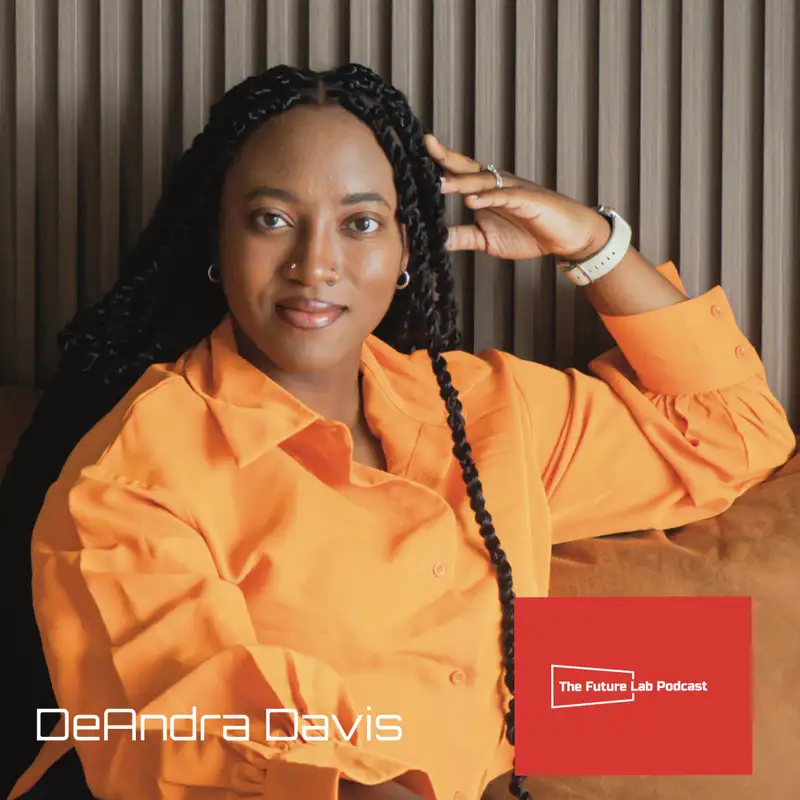
DeAndra Davis
This is a machine generated transcript. The audio version is the definitive version of the episode.
Lee (00:01.134)
DeAndra, welcome to the show. It's so great to have you here.
DeAndra Davis (00:09.265)
Absolutely.
DeAndra Davis (00:16.648)
Thank you, it's so good to be here.
Lee (00:18.838)
So people are reading less. This is kind of our focus for today. The stats say, if I look at my notes here, that people — and not just kids — are spending less time reading than ever. So is there a way to address this? Or we just won't win against the power of devices and screens?
DeAndra Davis (00:38.44)
Do you feel like there's ways to address it? I feel like there's no perfect answer, right? There is no perfect answer. I think that we have to think about what people want to read. I think we have to pay attention to, and I mean, I think I think in some ways publishing kind of does that, right? We're following trends in terms of looking at like, well, what are people picking up? What are people willing to pick up? In some ways, I know it's gonna sound weird, but you almost want the screens to invest more in reading, like on the back end.
I know that's going to sound strange, but people will go back and read The Hunger Games because they watched the movie. People will go back and read books because there's a movie or a TV show. You know, we saw it with The Summer I Turned Pretty, and we saw it again with We Were Liars, right? These were books that for me, I remember reading them in the early 2010s. And for me, they were huge at that time, right? They were hugely popular at that time.
So to see it coming back in 2026 and 2025 and these new — for kind of a new generation because it's on a screen and they don't necessarily only want to watch it, it's well what context am I missing that maybe was in the book that wasn't in the show, right? Or what context am I missing that was in the book that wasn't in the movie? Because of course, you know, us book nerds, we're always going to be like, but you don't know this because it was only in the book, right? We're always going to be those people.
And so I think I almost wish there was more investment in book IPs across multiple genres. I'm — again, I'm so happy to see it with things like The Summer I Turned Pretty and with We Were Liars, things that are a little bit more contemporary, things that are a little bit more grounded in realism and not just in like the fantasy, thriller, horror kind of space. I almost think that if we see more investment in adapting books, we'll see people going back and kind of reading books.
DeAndra Davis (02:37.11)
And I know that—that's not a perfect answer and that's not the only answer, but I do see a lot of drive in people making those connections, or even saying like, hey, if you like watching this thing you might like reading this thing, even if there's not a show for it. So I think that's all we can do. I think what we can do is continue to make suggestions, continue to think about, you know, the ways in which people are consuming media, what media people want to consume, and how we can help them connect with the things that they're already looking at.
And I also look at that too, like with video games. Like if you like to play this video game, you might like to read this thing. Right? People are in front of screens, but we can show them that there are things in books that are relating to the things that they're doing on their screens.
Lee (03:23.329)
That's fascinating. So what I'm hearing is it's kind of a synergy, it's kind of an ally situation, and everything is feeding into everything else. The question that brings up is, are books still just books? Has this affected how you are writing now or not? And is it just books are books, forever books?
DeAndra Davis (03:30.5)
Mm-hmm.
DeAndra Davis (03:40.264)
Mm-hmm.
DeAndra Davis (03:48.295)
So for me, books are still books, but I do think that it changes the way that I think about not how I'm writing but what I'm writing, if that makes sense. So when I wrote All the Noise at Once, I was not focused on anything to do with marketing or anything to do with reception.
I just kind of wrote the book that I felt like I needed to write at the time, with very little oversight or very little thought to how it would be received. I'm very, very lucky that it has been received so well and I'm so excited to see that reception. But I definitely wasn't thinking about that, right? I wasn't thinking about any sort of allyship in terms of being on a screen or how anybody would receive it. I genuinely wrote, I think, the type of book that I loved to read when I was younger and also the type of book that I needed to write.
I will say when it came to me writing The Lovers, the Liars, and Me, because now I'm on a contract and now I am thinking about those things, again, it didn't change the way that I was writing anything. But I definitely thought about subject matter and I started thinking more about, well, what are people interested in and what are people picking up more and what might make a wider audience want to pick up this book. And so The Lovers, the Liars, and Me, as opposed to All the Noise at Once, for example, it has more romance, right? It has more romance. Like All the Noise at Once is not a romance-heavy book. There's like a very romance-light, right? Diet romance in All the Noise at Once. But like The Lovers, the Liars, and Me—
Lee (05:22.431)
Mm-hmm.
DeAndra Davis (05:27.926)
—is a romance-heavy book. I wouldn't necessarily call it a romance book solely, but I would say that it definitely leans into romance. Does that make sense? And I thought about that. I thought about, you know, is this something that's easily marketable? Is this something that's more easily put into a one-sentence pitch? And that did change kind of what I was writing more than how I was writing it. But I still wanted to find ways to inject the things that I cared about along with that.
So even though it has the romance, it still has all of the trademarks of the things that I care about, right? Intersectionality, right? Those intersections of different identities and how they impact a character and the way that they're moving through the world — that still exists in The Lovers, the Liars, and Me. Teenagers dealing with hard things, things that are bigger than them, things that are, you know, societal issues that are impacting them — that still exists in The Lovers, the Liars, and Me. There's still important conversations happening.
But the way that I chose to present it and the things that I chose to add to it to make it a little bit more generally marketable, I definitely think were affected by me, you know, just being cognizant of the fact that, you know, people are not reading as much.
Lee (06:42.889)
Mm-hmm. Well, yeah, we all have to write the book that we want to read and write the book we have to. But side note, our local library is fantastic and I got All the Noise at Once as an audiobook yesterday and I was driving home. I said, I'm about to say it's amazing. It was so good. I had to pull over. I mean, I said this, it's so powerful, and the read — you know, the person doing the read is—
DeAndra Davis (06:59.112)
Love the audiobook.
Lee (07:11.833)
—so invested in and present, it wasn't — I had to stop. I had to stop the car and listen for a little bit. So these kind of parallel media pieces I could see could be pretty powerful. And it's just a different way of absorbing the book and, as you say, maybe come back to reading the book as a book, perhaps.
DeAndra Davis (07:33.363)
And I am pro audiobook. Like I am so pro audiobook. Whenever — I mean, I have to stop myself from being that person online when someone is like, “Audiobooks don't count as reading,” to be like, stop it. You don't get to say that. It counts. You consumed the book. You know what happened. It still counts. And audio—
Lee (07:45.449)
Yeah.
Lee (07:49.931)
You're committing nine hours. You're — you know, you're com— yeah. Yeah.
DeAndra Davis (07:51.539)
Right. You still committed the time. You committed the time. You know the information. If somebody asked you about it, you could tell them about it. You read that book, right? Just because you consumed it in a different way does not mean that you did not process it, right? In the same way. You still processed the information. And that's really all I care about, right? I love — and I mean, I'm so happy. I feel like twice in a row I have gotten amazing audiobooks and I'm so glad that you mentioned All the Noise at Once. It does have, I mean, a stellar audiobook.
André Santana did an amazing, amazing, amazing job narrating it. And it sounds beautiful. And to me, it elevates the story in a way that I didn't even think it could be further elevated. And it was amazing for me to listen to. So yeah, no, I'm pro-audiobook. And I think that's the thing, right? Everybody doesn't always get to have an audiobook, everybody doesn't always get that, and it's great for multiple reasons, right? Both for accessibility reasons, right? For the people who need that, but also—
Lee (08:32.621)
Mm. Mm.
DeAndra Davis (08:51.382)
So yeah, for the people who are maybe a little bit more resistant, who this is the only way they can do it. I know there have been times where for me it's been harder for me to get a book in. And I'm a reader. I mean, you can see all these books behind me. I'm a reader, but—
And the times when it's harder for me to squeeze a book in, you know, if I had my morning commute — like my morning commute used to be like an hour, my morning and afternoon commute used to be an hour — and I used to put an audiobook on and listen to an audiobook in the car. That's how I got through the entire — what is it? I can't remember the name of the series. It's by Holly Black, the fairy one. Yes, like Cruel— that I got through that entire tri— I got through that entire series on audiobook.
Lee (09:26.026)
Yeah, The Cruel Prince, the trilogy, or—
DeAndra Davis (09:32.593)
In the car. I got through that entire series on audiobook in the car. That's the only time I listened to it. I only listened to it in the car when I was commuting. And I was committed to it and I got through all of them and it was amazing. And I don't think that I lost anything from the way — I still bought them physically, but I don't think that I lost anything by consuming it that way. And so I'm definitely pro using whatever we can to bring people to books in whatever ways we can. Because oftentimes too, there are a lot of people who will say—
Lee (09:37.709)
Awesome.
DeAndra Davis (10:02.486)
I loved an audiobook so much that I bought the physical.
Lee (10:05.527)
Uh-huh. Yeah. For a while you could parallel read and listen, which I used to do, kind of alternating. Has any editor, agent, publisher said to you, hey, look, it's the age of social media, shorten up your sentences, write scenes like it's a movie, make it digestible, people are going to be scrolling this on a phone. Has anyone ever said anything like that to you?
DeAndra Davis (10:12.603)
Exactly.
DeAndra Davis (10:31.984)
Not yet. I have not run across that yet. So I'm still with — and I think I'm so blessed to still be with my original editor, because I have seen people lose editors in this business. But I'm still so blessed to be with my original editor that did both All the Noise at Once and The Lovers, the Liars, and Me and forthcoming things. I'm still with my same editor. And she's amazing. I remember, I think actually I was the one who was concerned, not so much for my sentences specifically being shorter, but the book itself being shorter.
Lee (10:50.977)
Yes, right.
DeAndra Davis (11:04.396)
I had concerns. So for The Lovers, the Liars, and Me — All the Noise at Once was already like 92,000 words and I was like, this thing is long. And I didn't mean for it to be that long, because when I sent it out to editors when we first sold it, it was only 66,000 words.
And so it gained all of those words, right? In the process of revision and fleshing it out. And I mean, in the finished product, I can't see anything that I would take out. I think that it is what it needed to be. And The Lovers, the Liars, and Me, similarly, when I first sent it to my editor, I want to say it was about 72,000 words. And then again it ballooned to like 100,000. And I was like, my god, I was so stressed out. I was like, this is so long. I was like, I feel like, you know, they keep talking about shorter books and people aren't reading, and maybe the book needs to be shorter.
And it was funny because my editor was the one who was like, the book needs to be as long as the book needs to be. She's like, we will edit to see if there's any unnecessary repetition or any places that we can cut that's not necessary. She's like, but we're not going to cut anything that's needed just for the sake of it being shorter. She said, we're not doing that, right? We will cut anything extraneous.
Lee (12:12.865)
Mm-hmm, mm-hmm.
DeAndra Davis (12:18.426)
But we're not cutting anything that's needed just for the sake of it being shorter. She's like, the book needs to be as long as the book needs to be. And she kind of comforted me a lot in it. So I have not run across that just yet. I am still trying to keep in mind keeping things a little bit on the shorter side. I do — I hope that my third YA will be a little bit snappier. I'm trying my best. I'm trying my best. But yeah, I—
Lee (12:24.973)
Wonderful.
Lee (12:44.545)
Yeah.
DeAndra Davis (12:48.35)
I have not come across that just yet. Not with my agent, not with my editor, not with my publisher. I think everyone has been pretty supportive of keeping things the way that they are, and nobody really steps on my toes too much when it comes to the creative side, like the actual writing side of it. I don't think anyone really steps on my toes too much.
Lee (13:08.631)
That's great. Wonderful. What do you think? Does this hold water, the idea that maybe smaller books — not shorter, but physically, make the book smaller? I mean, I know people are thinking of — because there's concern that after a certain age the research says and the kids say that they just kind of stop reading. Either school gets in the way, relationships consume them.
Maybe it's some kids don't make the transition from middle school books into, you know, young adult books. Something happens. So everyone's searching for something. Do you think it's the physical size of the book or is something else going on there?
DeAndra Davis (13:43.486)
Yeah.
DeAndra Davis (13:47.102)
Yeah.
DeAndra Davis (13:55.495)
I do think sometimes the physical size of a book can seem overwhelming, right? If you look at a book and it's humongous, you might be like, I don't know if I can do that, right? It's like when you walk into a really messy room that you know you have to clean and you're like, that's a lot, right? But then if you think to yourself, well, if I just clean this section and clean this section and clean this section, it'll be done eventually, right? But kids can't really conceptualize that, right? They do not yet have the frontal lobe, they lack the executive planning.
Lee (14:03.308)
Hm.
Lee (14:07.959)
Yeah.
DeAndra Davis (14:25.398)
And so for them it probably does look overwhelming. And so I do think for certain age ranges, yeah, we do probably want to consider a book looking physically smaller, looking less intimidating. But I also think sometimes it's — I think, okay, so I think it's a multi-step thing, and some of this — and I want to make it very, very clear, this is not a critique of education, because I am an educator.
But I think a part of the problem too is that so many schools have moved away from teaching entire books in favor of teaching passages and preparing kids for testing rather than actually consuming books as a whole. So a lot of times kids are not even reading whole books in school, whereas they used to, right? I know I used to. When I was in school, I read — and I remember the first time I read The Kite Runner, which was — that was a heavy book. I was in high school. I read The Kite Runner in high school, and that was a heavy book. It was an amazing, amazing book. Amazing book. Heavy. Not the thinnest book in the world. I would probably wager that it's probably a good 100,000-word book on its own.
And that was something where we were put into groups and we all had to read different books and then we had to present on it. We had to present the book to the rest of the class who didn't get to read that one. And so that was — I just feel like when I was in school we read entire books, and I find that it's rarer now where you're finding kids reading whole books, and so they're not even continuing that skill in school right now.
And I understand that that's not even necessarily the fault of teachers. I've spoken to teachers who say they would love to teach whole books, but maybe administration is down on it because the most important thing is, well, can a kid pick out the things in this very, very short passage? They're more concerned about testing and test scores and how that looks on a test. But the thing—
DeAndra Davis (16:22.752)
—they don't realize is that those things are transferable, right? If you could pick it out in a book, you could definitely pick it out in a paragraph, right? But it's difficult, right? And so they're dealing with a lot of restrictions, and a lot of them would love to continue to do that. But so not all kids are getting exposed to that, and I do think if they continued that skill all the way through school, that could potentially carry over into their real lives, because they already have that skill of reading larger books over time. And then I also think too, accessibility is a concern in terms of price. Price accessibility — hardcovers are expensive. Hardcovers do not cost what they used to cost.
And I'm very, very cognizant of that. I remember when I saw the price of my hardcover go up two dollars and I panicked, because I was like, no one's going to buy this. I was like, no one's going to buy this — this two dollar difference is enough to make — because to me I was like, I would quicker buy a book at $19.99 than I would at $21.99.
Lee (17:23.116)
Yeah.
DeAndra Davis (17:23.836)
And I knew that mentally. I was like, I would quicker buy it at $19.99 than $21.99. And even though that's only a $2 difference, I know that sometimes it's just that psychological thing, right? $19.99 just sounds significantly better than $21.99, even though it's only $2. And so I do think like, I don't know, maybe we need to just transition everything to mass market paperback.
Lee (17:37.709)
Sure.
DeAndra Davis (17:48.413)
I mean, I know a lot of people wouldn't like that. And I love — and mind you, this is me again, whole bunch of hardcovers behind me. I love a good hardcover. But I also know that it's not accessible for everyone to purchase all the time. They have to kind of wait for sales or, you know, wait until it goes on paperback. But the thing that they also don't know is that sometimes, you know, if you don't buy the hardcover, we don't get a paperback release. And so it'll never be in paperback, right? And so you'll never get it for that—
Lee (18:15.091)
Mm.
DeAndra Davis (18:18.326)
—cheaper price, or maybe it'll just completely go out of print. And so it's difficult. I think that there's a multi-layered issue there. Both again, the books need to be cheaper, the books do need to maybe appear smaller. And I think kids need more opportunities to continue reading whole books in school as well so that they can continue those habits. Because I think if it becomes a habit, it's something that they'll do in their off time.
Lee (18:46.177)
Yeah, because reading — it's this attraction for longer form stories, takes a little longer, it's more single focused, it's just a completely different skill, you know, that—
DeAndra Davis (18:59.688)
Mm-hmm.
Lee (19:00.311)
—people exercise when you read a book over a long time. This whole accessibility argument too is a good argument for libraries. I already have The Lovers, the Liars, and Me on hold. They haven't — they said on order. They haven't even bought the book yet, but people are putting it on hold. So, and your other book. Libraries.
DeAndra Davis (19:21.074)
That makes me so happy. I love libraries. I just have to say that I am so pro libraries. Librarians, libraries and educators have completely shown up for my books in a way that I cannot express enough gratitude for. If any librarians or educators are listening, I love y'all. Thank you so much. Because truly they have shown up for my books in such a big way. And I do think you're right, like accessibility — libraries make a huge difference because they do. They give it to you in different ways, right?
You can get the ebook, you can get the audiobook, you can get the physical book — however you want to consume this book, they have something for you. And so libraries are magical, but we know that there's also an attack on libraries, which is horrible.
Lee (20:05.291)
Well, yeah, that's true. And well, that's a whole other issue. I don't even know where to begin with that today. Maybe we'll cut that part out, or another time. I have a few interviews set up with librarians, and we're going to talk about all that. Would you share what you're reading now?
DeAndra Davis (20:09.533)
Yeah.
DeAndra Davis (20:13.652)
Yeah.
DeAndra Davis (20:19.807)
I love that.
DeAndra Davis (20:24.754)
Oh goodness. I am currently reading Wicked Endeavors by Kamilah Cole. I have not yet met a book by Kamilah Cole that I have not liked.
I've loved every single one of her books, and so I just started this one and it's a signed copy, which makes it even more special. But yeah, I'm currently reading Wicked Endeavors by Kamilah Cole and I am loving it so far. It is amazing. And I think coming off of reading An Arcane Inheritance by Kamilah, it is just — I think they just go so well together. But I'm reading that; I just finished Bound by Fury by Noelle Monét, which was kind of like a dark academia fantasy YA.
And that was really, really, really good. It was amazing. Very, very atmospheric. I mean, the writing was so lyrical and so beautiful. And I just adored it. So those are the last two things. Well, that's the last thing I read and then the thing that I'm currently reading.
Lee (21:27.757)
Cool. What does your workspace look like? Where do you write?
DeAndra Davis (21:31.165)
Oh goodness. So kind of where I'm sitting. I know you can't really see it, but this is my background. And so I have kind of like this little library behind me. I have like a U-shaped desk and I have a really, really fancy computer with like RGB lights. I'm a little bit extra. Anyone who follows me on social media has potentially seen me post my very, very large 49-inch monitor.
Lee (22:00.028)
Nice.
DeAndra Davis (22:00.918)
Before, on my story. I have a huge 49-inch monitor. It's very, very long horizontally. It's not like super tall, but it's very long horizontally. And I run it in dual screen mode. But I love it. I have this beautiful background, it's like a moving wallpaper, and it looks just gorgeous. And I hide all the icons and everything so you just see it. It's very atmospheric. But my workspace is — I like to keep it very botanical.
Right? It's like a lot of — like my mat for my mouse pad and everything, it has like leaves and flowers and things on it. But everything is white, like my computer's white, my desk is white. I like to keep things — and I think the only other things that I keep around me are like my tarot card collection and all of my many notebooks that I tell myself I'm going to use and don't use. And all of my many planners that I keep starting and forgetting to go back to. So that is my workspace.
Lee (22:43.177)
Cool.
Lee (22:48.299)
Right.
Lee (23:01.461)
That's good. Well, do you work predominantly in a digital space, would you say, or predominantly in some other kind of, you know, handwritten space?
DeAndra Davis (23:11.204)
It varies for me. And so—
I wanna say when I was working on All the Noise at Once, it was interesting because for whatever reason, All the Noise at Once — I was primarily digital when I was writing that one. And I don't know why. But I had notes all over the place and different drafts all over the place, and all of those existed in a digital format. The Lovers, the Liars, and Me, which is my most recent book, I found that I hand wrote a lot of things. And I even had like handwritten character profiles, which was really, really great.
Because I had like a love triangle going on and I really, really care about like character descriptions and kind of identifying features of characters, and so for The Lovers, the Liars, and Me I had like physical, handwritten — like, I have a notebook that I kind of do writing things in, and it's kind of a mess because I don't designate one notebook for one idea, so I have to kind of flip through and be like, this was for this thing and now this is for this thing. It just kind of jumps around. But yeah, I had physical handwritten profiles for Jaliya, for India, for Andre — yeah, for all of my characters.
And they all had like all of their — not just the way that they physically looked, but like what were their flaws, what were their biggest fears, what's their zodiac sign, what's their Myers-Briggs, what's their Myers-Briggs chart, like everything. And like when I say zodiac sign, I'm like, well, what's their sun, their moon, their rising, their Venus, their Mercury. Like, I know so much unnecessary stuff about my characters and I had these just very, very extensive—
Lee (24:29.357)
Mm.
DeAndra Davis (24:44.052)
—like handwritten character profiles specifically for The Lovers, the Liars, and Me. And that was really, really fun. So I think it varies for the book, like on what — because I'm currently working on an adult book that we're about to put out on sub. It's like an adult fantasy, and that one had the most handwritten stuff. I mean, all of the lore of the world and like character motivations and how that connected to the lore and where I thought the book was going to go and where I thought plot points would go and—
ideas and what-ifs — that had pages upon pages upon pages of handwritten stuff. So I think for me it just depends on the book.
Lee (25:20.927)
Interesting. Yeah. I was going to ask you, could you give us a hint about what you're working on? And I heard a little hint, adult fantasy, so that's something to look forward to.
DeAndra Davis (25:29.37)
Yes, so the two things—
The two things that I think I can maybe say something about. So my adult fantasy, I know I can say something about. That's not embargoed or anything, but because it's not officially out anywhere — we're going to go on sub with that soon. And so I have worked on an adult fantasy. It's kinda like horror fantasy because there's some scary stuff in there. But that's the most recent thing that I have worked on that, you know, fingers crossed, see if it lands. And then in terms of things on contract,
I do have more YA coming. And I guess the most that I will say is that I'm kind of going back to the spirit of my debut, in that I will have another autistic main character in my next YA. It will be a girl, an autistic girl, in my next one. And it's really going to be exploring kind of different things than what I explored in All the Noise at Once, and it's going to be a very, very different vibe.
Lee (26:02.718)
Yeah.
DeAndra Davis (26:31.542)
It is both serious and fun at the same time. Just picture kids gambling. It has like all of the shenanigans. It has all of the insane shenanigans of The Lovers, the Liars, and Me, because they got into some nonsense in that book. And so it has all of the shenanigans of The Lovers, the Liars, and Me with some of the seriousness of dealing with diagnosis, because we don't see Aiden get diagnosed in All the Noise at Once. He's already autistic when we meet him, but this one kind of deals more with actively getting diagnosed—
Lee (26:47.072)
Mm.
DeAndra Davis (27:01.462)
—and the kind of guardrails around that. And so yeah, that's what my next YA will be, and hopefully I don't get in trouble for saying that. But you know, hey, if I do, it's okay. I'll take that hit.
Lee (27:12.205)
Well, right, all right, good. Well, that's a good hint. I'm glad for that. We'll look forward to that. Is there anything else that I forgot to ask that you wanted to talk about?
DeAndra Davis (27:25.108)
No, no, I mean, you know, go check out The Lovers, the Liars, and Me if you haven't. I feel like so many people have already read All the Noise at Once and love it and laud it and say amazing things. The Lovers, the Liars, and Me, I promise, I feel like there's something in it for everyone. If you like romance, there's romance. If you like teen stories and coming of age, there's that. If you like a good, like, warm summer book, there's that. But also if you like, you know, people dealing with big problems, figuring themselves out, you know, confronting issues and finding their space in the world in a way that maybe can help you find your space in the world — I think that there's that as well.
Lee (28:06.269)
Wonderful. Well, thanks so much for doing this. This was a lot of fun, fascinating stuff, and I really appreciate you coming on the show.
DeAndra Davis (28:12.488)
Yes, thank you so much for having me.
Creators and Guests